Leak detection is the work of finding water you cannot see. It matters most when a leak is active and damaging, such as a ceiling stain that keeps growing or a floor that feels warm and wet. If that is your situation, shut off the main, then call (860) 397-8103. We answer 24/7, and a leak behind a wall does not respect business hours.
In slower cases the first sign is a number. Your water meter keeps moving when every fixture is off, or the bill jumps with no change in habits. Both are classic signs of a leak, and both are worth chasing before they turn into mold or a ruptured line.
Confirm a leak before you pay to chase one
Start with the meter. Turn off everything that uses water, then read the meter, wait twenty minutes without using any water, and read it again. Any movement means water is going somewhere. If the low-flow dial or triangle keeps spinning, you have a leak between the meter and your fixtures.
Next, check the usual suspects. A toilet flapper that does not seal can waste an alarming amount without making noise. Put a few drops of food coloring in the tank, wait fifteen minutes without flushing, and see whether color shows in the bowl. If it does, a cheap flapper may be the whole problem.
How we find a hidden leak
| Method | What it finds | Best for |
|---|---|---|
| Pressure test | Whether a supply line is holding pressure | Narrowing a leak to one section of line |
| Acoustic listening | The hiss of water escaping under pressure | Slab and buried line leaks |
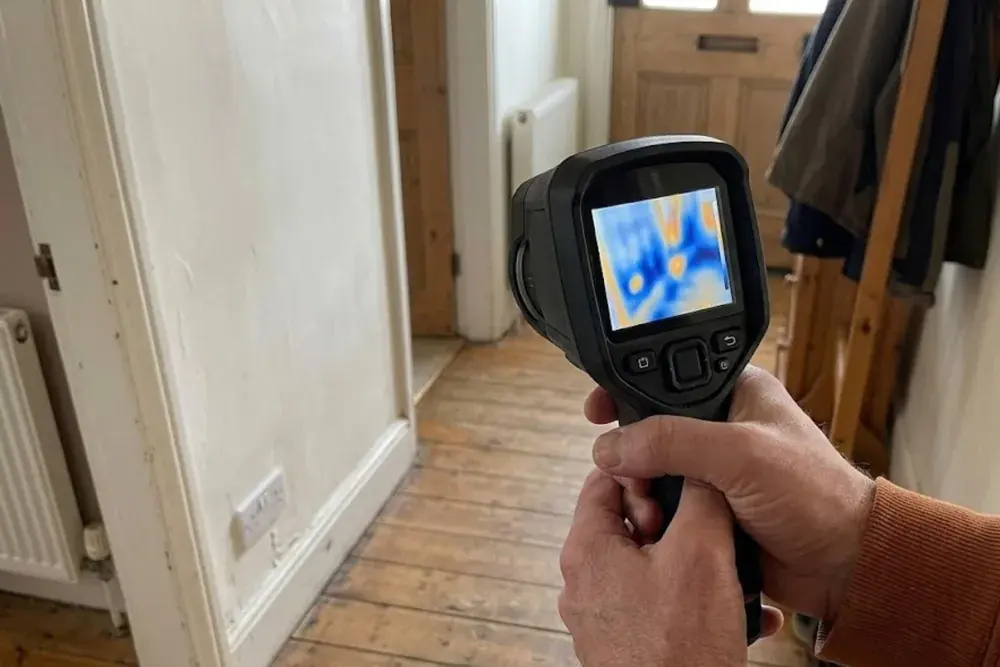
| Thermal imaging | Temperature differences from wet material | Walls, ceilings and radiant heat lines |
| Moisture meter | Dampness inside drywall, wood and subfloor | Confirming the edge of a wet area |
| Camera inspection | Cracks and offsets inside drain lines | Suspected drain or sewer leaks |
No single tool solves everything. We combine them, because a thermal image can show a cool patch that turns out to be condensation, and a listening device can pick up a neighbor's irrigation. Cross-checking two methods is what turns a guess into a spot on the floor you can mark with an X.
Seeing water or a stain that keeps spreading? Call the 24/7 line.
Call (860) 397-8103Where leaks hide in older Windsor homes
Homes near Windsor Center and along Poquonock Avenue include many decades of plumbing work layered on top of each other. Galvanized lines get pinholes, copper gets pitted where flux was left behind, and a past remodel may have buried a joint behind tile. Leaks also show up at basement walls, where a failing water line or a drain can look like groundwater.
Windsor is also a river town, with the Farmington and Connecticut Rivers on its edges and several brooks inside the town limits. Not every wet basement is a plumbing leak, so we check whether the water follows the supply lines or arrives after rain. If it is groundwater, a sump pump or basement waterproofing may be the right answer instead.
High water bill? Start here
A high bill with no visible leak is one of the most common reasons people call. Windsor is served by the MDC for water, and a sudden jump on the bill usually reflects real water use somewhere. Common culprits are a running toilet, a leaking irrigation zone, a failed water heater relief valve, or a service line leaking outdoors.
A service line leak between the street and your house can run for weeks without showing on the surface. If the meter keeps moving with all fixtures off, we will check the line before anyone digs. For repairs, see water line repair and replacement.
Ceiling, wall and crawlspace leaks
A stain on a ceiling or a bubble in wall paint is water that has already traveled. The source is often somewhere above or beside the stain, and the wet spot shows where water finally reached a surface. We trace it with a moisture meter and a thermal camera, then open the smallest area that proves the source.
Under-house and crawlspace leaks are easier to reach but easy to miss. Dripping from a joint can run along a joist and drop somewhere else. If you smell damp air or see wet insulation under the floor, call before the subfloor stays wet long enough to rot.
Slab leaks and buried lines
A slab leak is a supply line leaking under a concrete floor. Warm spots on the floor, the sound of running water with every tap off and a bill that keeps climbing are the usual signs. Hot water lines leak more often than cold ones, so the floor can feel warm in one spot.
Buried lines outside the house, including the service line, can leak without any surface sign. Listening equipment and a pressure test locate them before anyone digs. Repair choices include a local fix, a reroute through the walls or replacing the line, and we lay them out so you can compare.
Irrigation, meter boxes and pools
Lawn sprinkler systems leak at heads, valves and buried fittings, and a stuck zone valve can run for days. Water that bubbles up near the meter box can be a leaking connection on the utility side or on yours, which matters for who repairs it. If you have a pool or spa, a drop in water level that exceeds evaporation points to a leak in the shell or the plumbing, and we can test the pipes.
What happens after we find it
We give you the location, the cause and the repair options in plain language. Some leaks need only a fitting replaced through a small access opening. Others, such as a corroded run, are better handled by replacing the section or the whole line. You decide, and the work is scheduled at your pace unless water is actively causing damage.
Frequently asked questions
Yes. If water is actively leaking and you cannot stop it at the main, call (860) 397-8103 any time. The line is answered 24/7. For slow leaks and bill questions we schedule same-day appointments when available.
Warm spots on the floor, the sound of running water when everything is off, a sudden bill increase or a damp patch with no source above are common signs. A listening test and pressure test can confirm it without breaking concrete.
Not usually at first. Detection tools narrow the leak to a small area, so any opening is limited to that spot. We tell you what we expect before we cut.
Yes. A silent flapper leak can pass a large volume over a month. Try the food coloring test before you call, since it takes fifteen minutes and costs nothing.
Drain and sewer leaks need a camera inspection rather than a pressure test. We can run a camera through your line, and you can read about that on our sewer camera inspection page.
Yes. We dispatch across the whole town, including Wilson, Hayden Station, Poquonock and Windsor Center, plus nearby towns such as Bloomfield and South Windsor.
Need a plumber for this right now? The line is answered around the clock.
Call (860) 397-8103