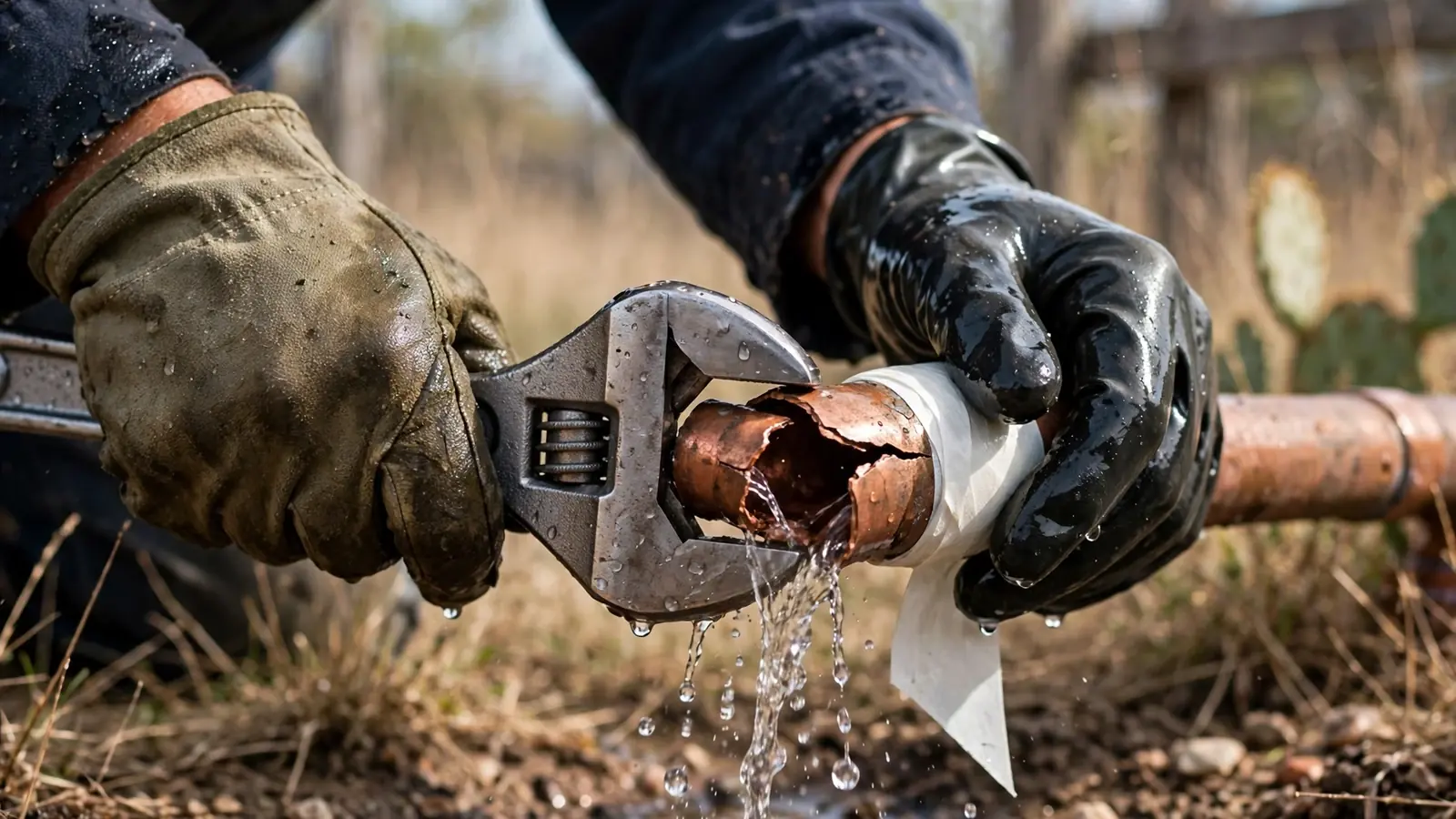
Burst pipe repair in Windsor, CT starts before anyone arrives. Close the main shutoff valve inside your home, open the lowest faucet to drain the lines, and switch off power to any room where water is touching outlets or appliances. Then call (860) 397-8103. The line is answered 24/7, so a 2 a.m. split in a basement ceiling gets the same attention as a Tuesday morning call.
Most bursts are not dramatic geysers. They start as a pinhole, a failed solder joint or a swollen section where ice formed, and they keep leaking quietly behind drywall until a stain shows up. That is why the first job is always finding every wet area, not just the spot you can see.
When a burst pipe is an emergency
Treat it as an emergency any time water is flowing and you cannot stop it with the main valve, any time it is near the electrical panel, or any time the ceiling below is sagging. Water weighs about eight pounds a gallon, and a bulging ceiling can come down without much warning.
If you cannot close the main, call us and also call the water utility. Windsor is an MDC member town, and the MDC can advise on its side of the meter. Do not wrestle with the street-side curb valve unless the utility tells you to.
What to do while you wait
Four steps buy you time and limit the damage.
- Close the main shutoff It is usually where the water line enters the basement or crawl space. Turn it clockwise until it stops.
- Drain the lines Open the lowest tap and flush upstairs toilets once to relieve pressure.
- Kill power near the water Use the breaker, not a wet switch. If the panel is wet, stay away and call the electric utility.
- Move valuables and photograph the damage Insurers ask for pictures taken before cleanup starts.
Why pipes split in Windsor homes
Freezing is the headline cause, but it is not the only one. Windsor sits where the Farmington River meets the Connecticut River, and winters here swing from deep cold to thaw and back. A pipe in an exterior wall, an unheated garage or a crawl space under a Poquonock ranch can freeze overnight, then split when the ice melts and pressure returns.
Age is the second cause. Older galvanized steel corrodes from the inside, so the wall gets thin long before the pipe looks bad. Copper fails at joints and elbows, and some early plastic fittings go brittle. A repair that fixes one failure but ignores the rest of the line tends to bring you back in a year.
That is the reason we test the surrounding run before closing the wall. If the next elbow is pitted or the pipe is soft to the touch, we tell you and show you.
Water still running? A plumber can talk you through the shutoff by phone.
Call (860) 397-8103How the repair works
| Pipe type | Typical failure | Usual repair |
|---|---|---|
| Copper | Split from freezing, pinhole from pitting, failed solder joint | Cut out the damaged section and sweat in new copper or use press fittings |
| PEX | Split near a fitting, rodent damage, ice expansion | Replace the section with a crimped or expansion fitting |
| Galvanized steel | Internal corrosion, thin walls, leaking threads | Replace the run or the whole line, since the rest is usually near its end |
| CPVC and PVC | Brittle cracks at fittings | Cut and couple, then check nearby fittings |
After the water is off we locate the full break, cut back to sound pipe, and make the repair to code. Pressure testing follows, so we know the line holds before drywall goes back. If walls or floors got wet, we point you to drying and restoration contacts, and we keep our own work on the plumbing side.
Documenting damage for your insurer
Burst pipe claims go smoother with a clear record. Take wide photos and close-ups before moving anything, keep the failed pipe section if you can, and ask the plumber to note the cause on the invoice. Many policies treat sudden bursts differently from slow leaks, so the cause matters.
We can describe what failed and where. We do not speak for your insurer, so read your policy or call your agent about coverage.
Preventing the next one
Insulate pipes in garages, crawl spaces and exterior walls. Know where your main shutoff is and test it once a year. In a hard freeze, let a thin stream run from the faucet farthest from the main, and open cabinet doors under sinks on outside walls. If you are leaving for a stretch in winter, keep the heat on and have someone check the house.
Ready to replace the failing run instead of patching it? See whole-house repiping or ask about leak detection if you suspect hidden moisture elsewhere.
Frequently asked questions
Yes. The line is answered 24/7, including holidays. Call (860) 397-8103, tell the dispatcher where the water is coming from, and follow the shutoff steps while a plumber is arranged. Same-day appointments are offered when available.
Look where the water line enters the house, often in the basement near the front wall, in a utility room or in a crawl space. It is a round wheel handle or a lever. Locate it before you need it, and tag it so anyone in the house can find it.
Usually yes once the plumber has pressure tested the repair and flushed the lines. Run cold taps for a few minutes to clear air and debris, and check the repair area again after an hour.
No. A frozen pipe may still be intact, and thawing it slowly can avoid a break. A burst pipe has split and leaks. If a frozen pipe is bulging or you hear dripping inside the wall, shut off the main and call.
Our work is the plumbing: stopping the leak and repairing the pipe. Drywall, flooring and drying are separate trades, and we can tell you what we saw so your restoration contractor and insurer have a clear picture.
Yes. We dispatch to every part of Windsor, including Windsor Center, Poquonock, Wilson and Hayden Station, and to the ZIP codes 06095 and 06006.
Need a plumber for this right now? The line is answered around the clock.
Call (860) 397-8103