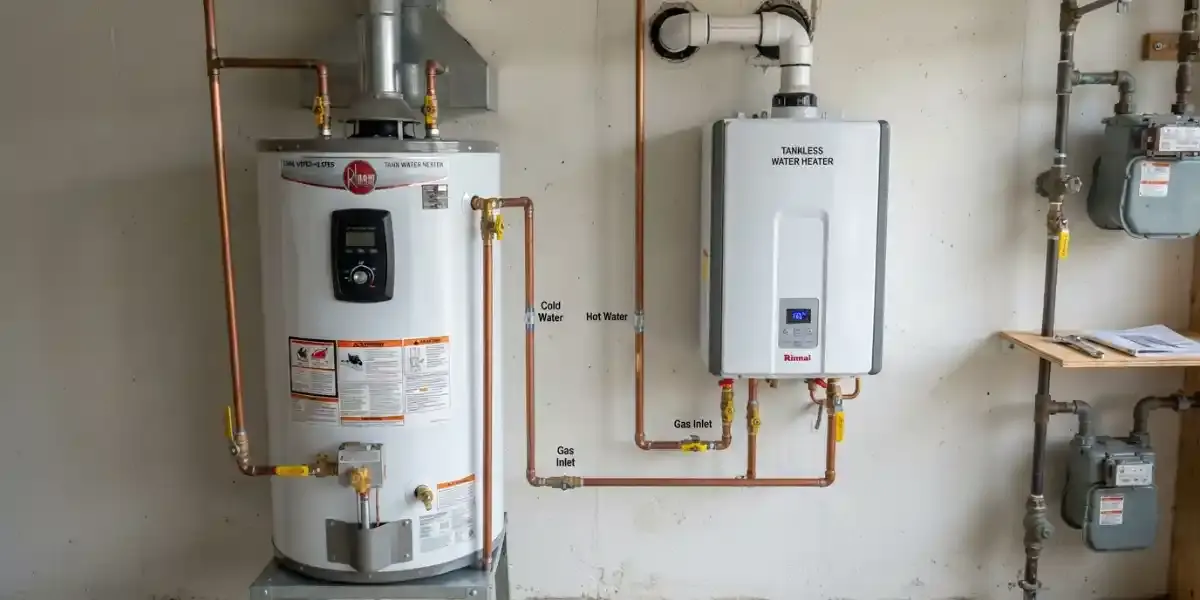
A tank heater is sized by how much hot water it stores. A tankless heater has no storage, so it is sized by how much hot water it can make at once. Two numbers decide that: the flow rate you need in gallons per minute and the temperature rise from your cold supply to your set point. Get those right and the unit performs. Get them wrong and showers run cold when someone opens a second tap.
Step one: count your peak demand
Add up the fixtures that might run at the same time. A shower uses a modest flow, a kitchen faucet a bit less, and a dishwasher or washing machine adds more. You do not add everything in the house. You add what realistically runs together, such as two showers and a dishwasher on a busy morning.
Fixture flow rates vary, so check the labels on your showerheads and faucets. Newer fixtures use less water than older ones, which can mean you need a smaller unit.
| Scenario | Fixtures in use | Planning note |
|---|---|---|
| Couple, one bathroom | One shower, maybe a kitchen tap | A smaller unit usually works |
| Family of four | Two showers or a shower plus laundry | Plan for higher flow |
| Large household or guests | Three or more fixtures at once | A large unit or two units |
| Soaker tub or body sprays | High-volume fixtures | Size for the largest single draw |
Step two: find the temperature rise
Temperature rise is the difference between the incoming cold water and the hot water you want. Cold water in New England runs much colder in winter than in summer, so size for the cold season. If your incoming water is quite cold and you want hot water at a comfortable shower temperature, the unit has to work harder, and its flow capacity drops.
That is why a unit that looks big enough in a catalog can disappoint in January. Manufacturers publish flow rates at different temperature rises, and a good plumber reads those charts for your actual conditions.
Want the numbers worked out for your house? Call and ask for a sizing visit.
Call (860) 397-8103Step three: check the gas line, power and venting
Whole-house tankless units that burn gas need a lot of gas, much more than a tank heater. An existing half-inch line may not carry enough, and the gas meter may also limit the total. Electric units need major electrical capacity, sometimes more than an older panel has.
Venting is the third limit. High-efficiency gas units use plastic vent pipe that can run through a wall, but they need specific routing and a condensate drain. We look at all three before we recommend a model, and our page on tankless water heater service explains what we check.
Sizing notes for Windsor-area homes
Water in Windsor comes from the MDC, which publishes an annual water quality report. We do not state hardness figures from memory, and you should not size or maintain a unit around a guess. Test your tap or read the report. Scale reduces a tankless unit's performance and calls for regular flushing.
If your house is outside Windsor, supply differs. State records list several utilities for nearby towns, including Connecticut Water for parts of Windsor Locks and the MDC, Manchester Water and Connecticut Water for South Windsor. A house on a private well, as in much of East Granby, has pressure and water quality questions of its own.
Source type: MDC water quality reporting and state records of water utilities by town.
Common sizing mistakes
The first mistake is sizing by the number of bathrooms instead of by peak flow. The second is ignoring winter inlet temperature. The third is forgetting that long pipe runs make you waste water waiting for heat, which no heater size fixes. A recirculation loop or a point-of-use unit can help in a long house.
A fourth mistake is choosing a unit based on price alone. A smaller unit that cannot keep up is not a bargain, and an oversized unit may not run at a good efficiency in low-demand periods.
Should you go tankless at all?
Tankless suits households that value continuous hot water and floor space and are ready to maintain the unit. A standard tank is simpler and cheaper up front. If you are weighing both, our water heater installation page lays out the tradeoffs. If your existing tank is failing now, water heater replacement covers urgent swaps.
We serve homes in East Granby and Windsor Locks as well as Windsor, and the gas and venting questions come up in all of them.
A quick sizing worksheet
Bring these notes to a plumber. They make a sizing visit much faster.
- List peak fixtures Write down every tap, shower and appliance that could run at the same moment.
- Note each flow rate Use the label on the fixture or measure with a bucket and a timer.
- Pick a winter inlet temperature Plan for the coldest water of the year, not the average.
- Check gas or electric capacity Confirm the line, the meter or the panel can support the unit.
- Compare manufacturer charts Match your flow and temperature rise to the published ratings.
If your numbers fall between two models, the larger one gives margin for future changes, such as an added bathroom. If your household is small and your fixtures are efficient, the smaller model is usually enough. A short visit to see the gas line and venting path often settles the question.
Frequently asked questions
It depends on peak demand and winter inlet temperature. Add the flow of fixtures that run together, then check the manufacturer's flow chart at your temperature rise.
Often yes, if the unit is sized for it. Gas models usually handle more simultaneous flow than electric ones.
Often yes. Tankless units draw more gas than tanks, and the line and meter must supply it.
It does not change the size, but scale reduces performance over time. Plan an annual flush and test your tap.
We do not guess. The MDC publishes an annual water quality report, and a tap test gives you your own result.
Plumbing problem that cannot wait? Call the 24/7 line.
Call (860) 397-8103