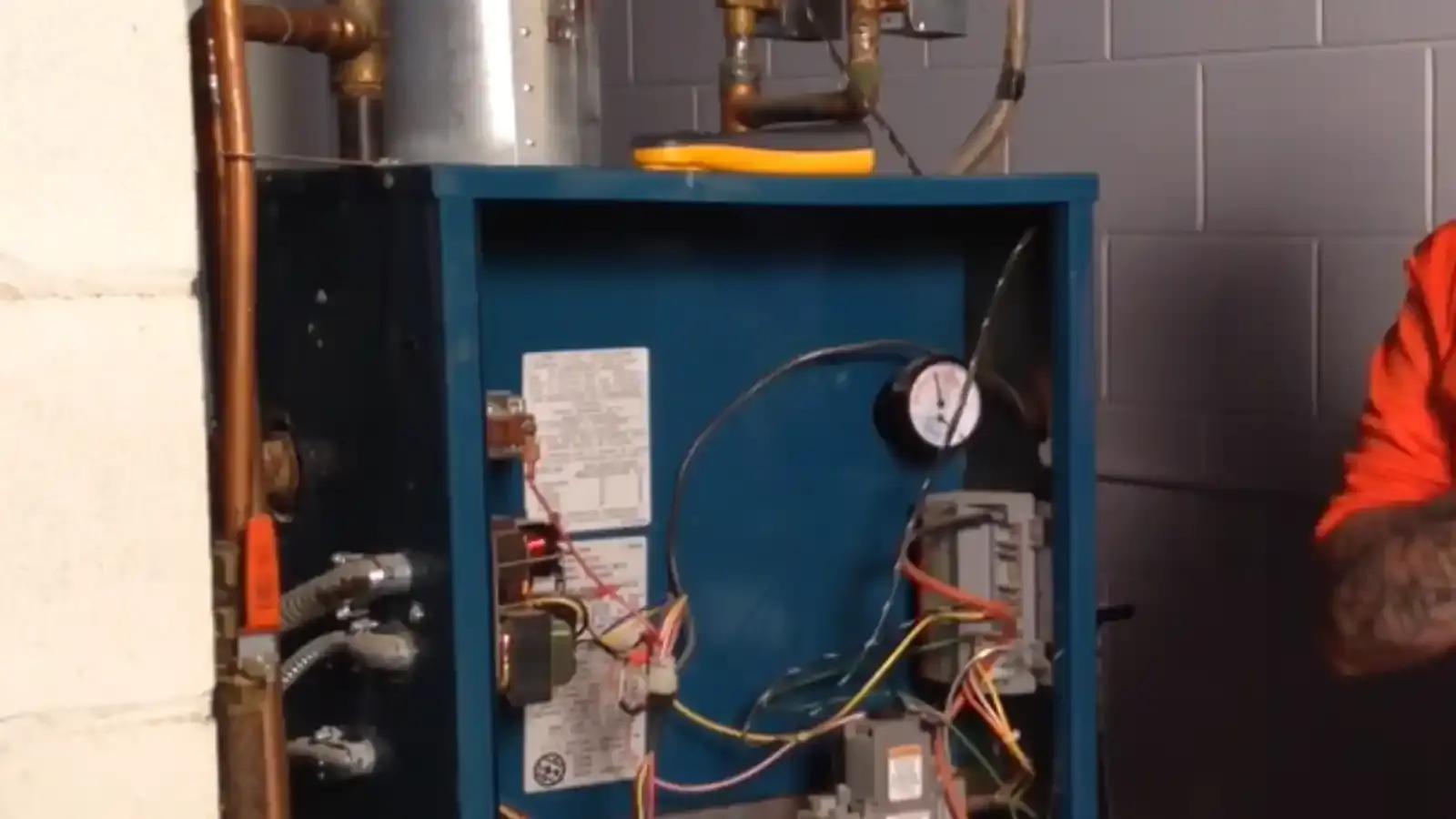
Boiler tubes sit inside the heat exchanger, the part that transfers heat from the burner to the water. In a larger boiler, water or hot gases flow through banks of tubes. When a tube leaks or clogs, the boiler loses efficiency, leaks water or trips off on a safety control.
Most Windsor homes have smaller residential boilers, which use cast iron sections or a compact copper or steel exchanger instead of long tube banks. The principle is similar, and the repair question is the same: can the damaged part be fixed, or is the boiler past it?
Where tubes and heat exchangers fit
| Boiler type | Heat transfer part | Typical weak point |
|---|---|---|
| Cast iron sectional | Iron sections joined with gaskets or nipples | Cracked sections, failed gaskets |
| Steel fire-tube | Hot gases through tubes surrounded by water | Corrosion and scale inside tubes |
| Water-tube | Water through tubes surrounded by hot gases | Scale, overheating, thin tube walls |
| Modern condensing | Compact stainless or aluminum exchanger | Condensate corrosion, blockage |
If your boiler is a commercial or multi-unit unit, true tube replacement may be on the table. For a typical home boiler, the question is usually whether a section, a coil or the whole boiler should be replaced.
Signs of a leaking heat exchanger
What to watch for
- Water around the boiler base It may be a failed fitting or a leak inside the exchanger.
- Frequent pressure drops The system keeps losing water and needs refilling.
- Rust-colored water or sludge Corrosion inside the system.
- Banging or kettling Scale or low flow can cause tubes to overheat.
- Soot or unusual odors Combustion problems should be checked by a heating specialist.
Boiler leaking or losing pressure? Call before it fails in the cold.
Call (860) 397-8103Repair or replace
A leak from a fitting, a valve or a circulator flange is a simple repair. A leak inside the heat exchanger is different. Some exchanger problems can be repaired or a section replaced. Many cannot, or the repair cost approaches that of a new boiler.
Age and condition drive the answer. A boiler that has served for decades and is leaking from its exchanger is usually at the end of its life. A younger boiler with a covered part may be worth repairing. We tell you plainly which case you are in. Burner and combustion service falls to a heating specialist, and we say so when that is the issue.
Heating plumbing in Windsor homes
Windsor is an MDC member town, and the MDC supplies the water that fills your heating system. Adding make-up water to a boiler that keeps losing pressure brings in fresh oxygen and minerals that speed corrosion, which is one reason to find the leak early. A pressure drop that repeats is a symptom to check, not a thing to keep topping off.
Many Windsor homes date from periods when hot-water baseboard and radiators were standard. Systems near Windsor Center and Poquonock Avenue may have been modified repeatedly. A plumber should look at the whole loop, including zone valves, circulators and the expansion tank.
Source type: MDC member-town information and general hydronic system practice.
Plumbing work around a boiler
The plumbing side includes the fill valve, the backflow preventer, the relief valve and its discharge pipe, the expansion tank and the piping to each zone. These parts fail more often than the exchanger does. Replacing a failed fill valve or a waterlogged expansion tank often solves pressure problems.
Our boiler repair page covers what we handle. If the boiler also heats your domestic hot water, see water heater repair.
Plan ahead for winter
Service your boiler before the heating season. Look for drips, rust and pressure swings. Know where the shutoff and the zone valves are. If the system fails in winter, open cabinet doors on outside walls and let a thin trickle run to protect pipes while you arrange service.
We cover heating plumbing across the region, including Bloomfield and Windsor Locks.
Questions to ask when a boiler is leaking
Where exactly is the water coming from? A fitting, a valve and the heat exchanger are three very different repairs. How old is the boiler, and has the pressure been dropping for weeks? Has the system been refilled often, and has anyone checked the expansion tank?
Ask the plumber to show you the leak and explain whether it is repairable. Ask what happens to the rest of the system if you keep refilling it. Ask whether a heating specialist should check the burner and combustion. Good answers are specific, and they come with a plan before the cold weather.
Signs a boiler is near the end of its life
Frequent repairs, rising fuel use, a noisy or rumbling system and rust around the base are common signs. A boiler that needs a new part every season is telling you something. So is one that cannot hold pressure after the leaks have been fixed.
When that point arrives, you have time to plan if you act before winter. Get a written assessment, ask about the plumbing changes a replacement needs and compare options calmly, not in a cold house at midnight.
What to do if you smell gas or a CO alarm sounds
Leave the building and call 911 from outside. Do not relight a pilot, flip switches or try to inspect the boiler. Call the gas utility from a safe place. If there is no gas smell and no alarm but the boiler is leaking, shut it off, close its water feed if you can reach it safely and call a plumber. Do not run a leaking boiler.
Frequently asked questions
In larger boilers, tubes carry water or hot gases through the heat exchanger. Home boilers often use cast iron sections or a compact exchanger instead.
Sometimes. Many are replaced, and the whole boiler may be the better investment.
A leak, a failed expansion tank or a bad fill valve are common causes.
Yes. It may mean overpressure. Do not cap it.
We handle the water side and plumbing. Burner service goes to a heating specialist.
Plumbing problem that cannot wait? Call the 24/7 line.
Call (860) 397-8103