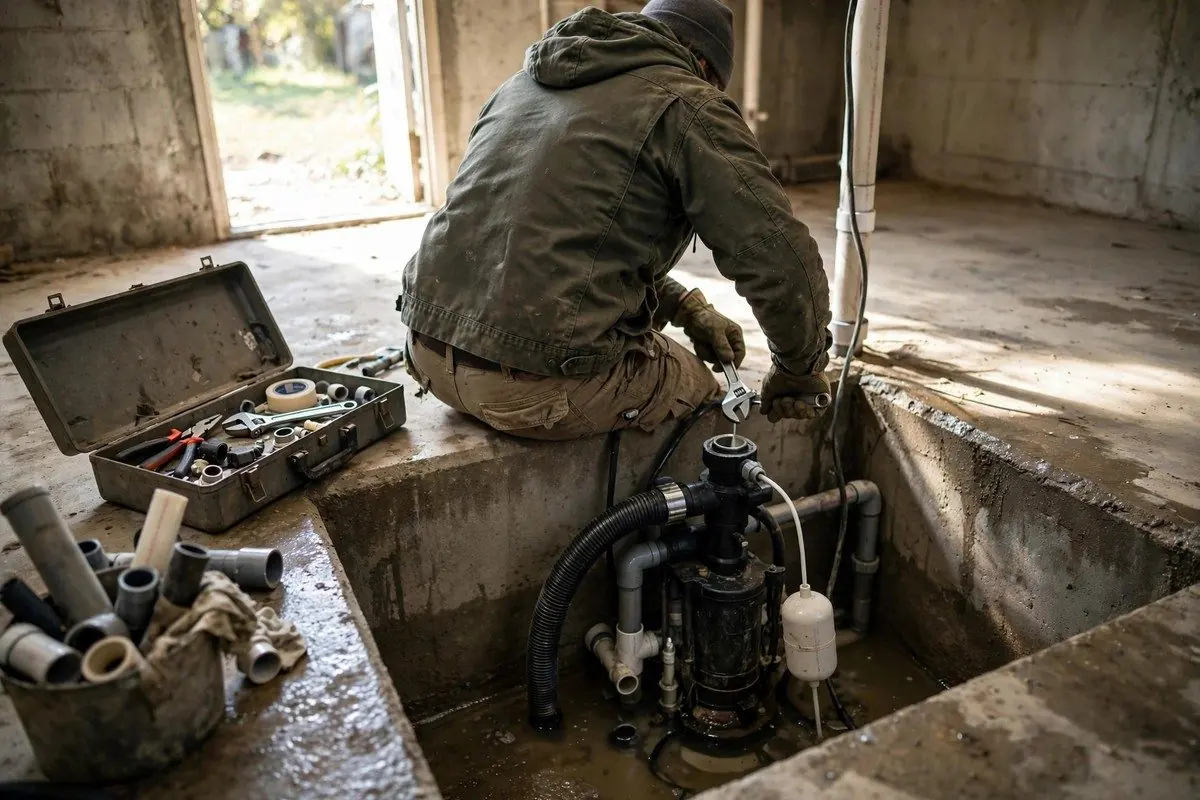
Heavy rain and power outages arrive together. That is the problem with a basement that depends on a single electric sump pump. When the grid drops, the pit fills and nothing pumps it out. A battery backup is a second pump with its own battery that takes over when the primary pump stops. It is one of the most practical upgrades for a wet basement.
How a backup system is built
A typical backup system has a second pump, a battery, a charger and a controller. The backup pump sits in the same pit, a bit higher than the primary, so it only runs if the water rises above the primary's float. The controller sends a signal when the battery is low or the pump runs. The charger keeps the battery topped up from household power.
Some systems have a separate discharge line for the backup. Others tie into the primary's discharge with a second check valve. Both can work, and the right choice depends on the pit and the piping.
| Part | Job | What to watch |
|---|---|---|
| Backup pump | Moves water if the primary fails | Capacity should match the primary as closely as possible |
| Battery | Runs the backup during outages | Needs replacement every few years |
| Charger and controller | Keep the battery ready and send alerts | Test the alarm every season |
| Check valves | Stop pumped water from flowing back | Replace if they stick or clatter |
| Discharge line | Carries water outside | Must drain away from the foundation and not freeze |
Basement pump without a backup? Call to plan one before the next storm.
Call (860) 397-8103Installation step by step
We start with the pit. It should be deep and wide enough to hold both pumps, clean of debris and fitted with a lid. We set the backup pump so its float triggers above the primary's. The battery goes in a ventilated spot off the floor, since a flood should not reach it. We connect the discharge, test both pumps with water and trigger the alarm.
If your pit is small, we may recommend widening it. If the discharge line is old or undersized, we correct it. A backup is only as good as the line that carries water away.
Why a backup matters in Windsor
Windsor sits at the junction of the Farmington and Connecticut Rivers and includes Mill, Meadow, Deckers, Phelps and Rainbow Brooks. The town's hazard planning documents cite flooding in 1984, 2003 and 2005 in the Mill, Meadow and Deckers watersheds, and they list Batchelder Road, Pleasant Street and River Street as areas at risk of flooding. Windsor also has repetitive loss properties on its record.
In nearby Windsor Locks, the town's documents describe backyard flooding in October 2005 on Gaylord and Lowndes Drive, and one Center Street house with basement water in every flood. In South Windsor, summer 2021 storms flooded below the Veteran's Park dam. A backup pump will not stop a river, but it can keep a basement dry through an outage.
Source type: Capitol Region Council of Governments hazard mitigation plan annexes for Windsor, Windsor Locks and South Windsor.
Keeping the system healthy
Test the system a few times a year. Pour water into the pit until the primary pump starts. Unplug the primary and pour water again to see the backup run. Check the battery for corrosion and the date on its label. Replace it on schedule. Clean the pit and the pump intake of silt and debris, which are the most common reasons a pump fails.
Discharge freezing is a seasonal risk. A line that runs to a spot where water can pool and freeze can back up into the pit. Direct the discharge to a spot that drains.
Related choices
A water-powered backup uses household water pressure instead of a battery, which works where municipal pressure is dependable and rules allow. It does not suit private wells. If you have recurring seepage along the walls, a pump alone may not be enough, and basement waterproofing covers interior drains. Our sump pump page explains repair and replacement.
We install backups across the region, including Bloomfield and Windsor Locks.
Installation mistakes we see
The most common mistake is a backup pump with far less capacity than the primary. It keeps the pit from overflowing in a light event and fails in a heavy one. Another is a missing or backward check valve, which lets water in the discharge line run back into the pit and restart the pump over and over.
A third is a discharge that ends close to the foundation, where the water drains right back toward the basement. A fourth is no alarm, so nobody learns the battery died. Each is simple to correct when the system is installed, and harder to find during a storm.
A seasonal test routine
Test the pumps in early spring and again in the fall. Fill the pit with a bucket of water until the primary starts, confirm it empties the pit and shuts off, then unplug it and repeat with the backup. Look at the discharge outlet outside to confirm water leaves the pipe and drains away from the foundation.
Check the float switches move freely and are not wedged against the pit wall. Write the date of each test on a card near the pit. A pump that is tested twice a year is far more likely to start when a storm arrives.
Safety when a sump pit fails
Do not reach into a pit or touch a pump while it is plugged in, and do not stand in basement water if outlets or a panel are close. Shut off power only if you can reach the panel dry. If the pump has failed and water is rising, move valuables up and call a plumber. When to call 911 instead: gas smell or a person in danger.
Frequently asked questions
It depends on battery size and how hard the pump works. Ask for runtime figures at your inflow, and consider a larger battery for flood-prone basements.
A good pump still stops when power fails. A backup covers that gap.
Often yes, if the pit is large enough and the discharge is sound.
Follow the manufacturer's schedule. Many batteries need replacement every few years, and testing tells you when.
The town's hazard plan lists Batchelder Road, Pleasant Street and River Street among areas at risk of flooding.
Plumbing problem that cannot wait? Call the 24/7 line.
Call (860) 397-8103