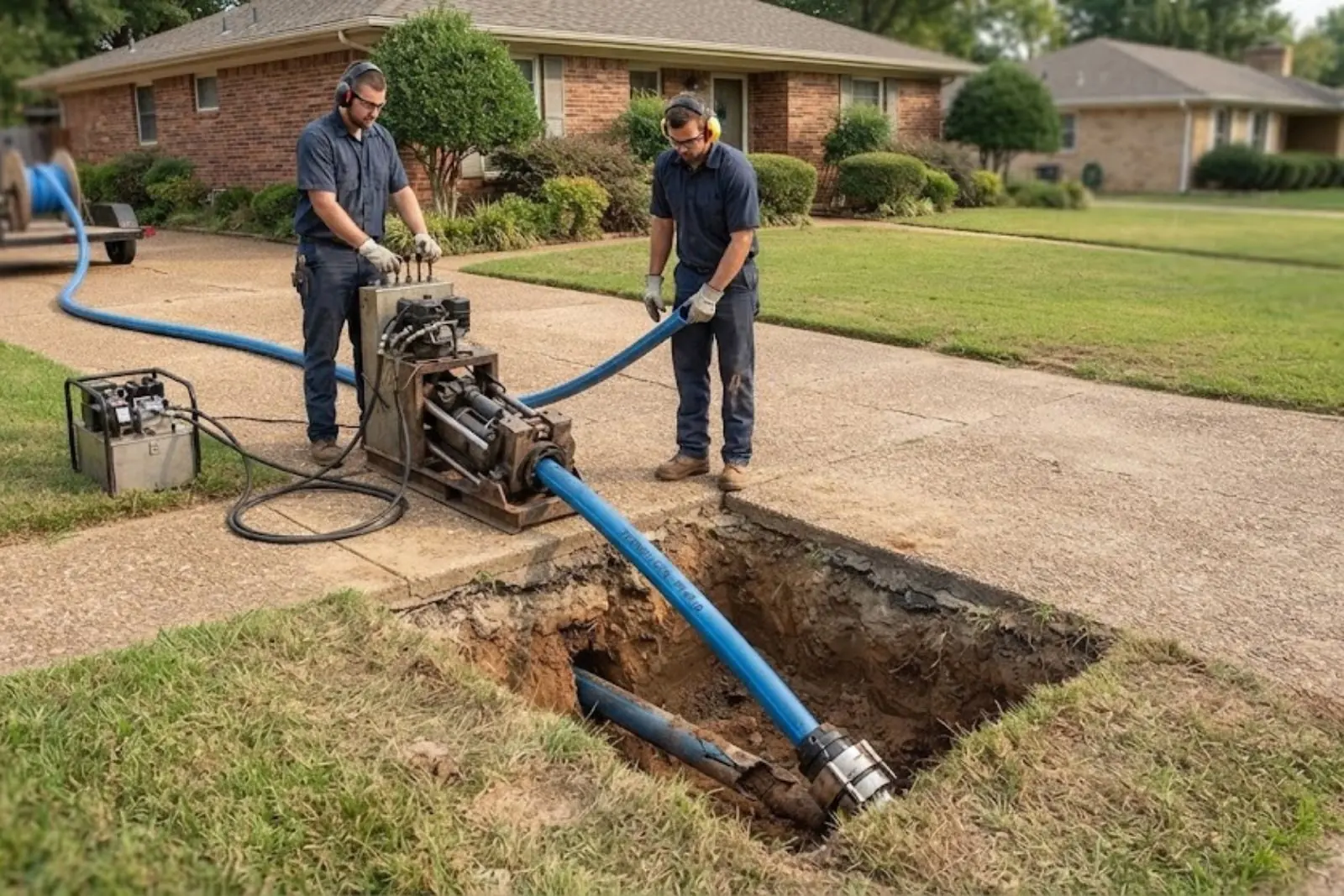
Cured-in-place pipe lining is a way to repair a cracked or root-infested sewer line without digging up the whole yard. A felt tube soaked in resin is pulled or inflated into the old pipe, then hardened with steam, hot water or light. The result is a new pipe inside the old one. It is a good fit for some Windsor homes and a poor fit for others, and the difference comes down to the condition of the existing pipe.
How the lining process works
Lining starts with cleaning. The pipe has to be clear of roots, scale and debris so the liner can bond smoothly. We clean with a cable or with hydro jetting, then send a camera through to confirm the pipe is ready.
Next, a flexible tube saturated with epoxy resin is pushed through an access point, usually a cleanout or a small excavation at one end. It is inflated against the pipe wall and cured. After it hardens, we reopen any side connections with a cutter, then run a final camera pass to check the result.
| Step | What happens | Why it matters |
|---|---|---|
| Camera inspection | We record the line and locate defects | Shows whether lining is possible |
| Cleaning | Roots and scale are removed | A smooth surface lets the liner bond |
| Liner placement | A resin-soaked tube is positioned | It must match the pipe diameter |
| Curing | Heat or light hardens the resin | Creates the new structural wall |
| Reinstatement | Side connections are reopened | Restores flow from branch lines |
| Final camera pass | We verify the finished pipe | Documents the work |
What lining can repair
Lining works well on cracks, joint offsets that are minor, root intrusion at joints and general deterioration along a straight run of pipe. It seals the leak points that let roots in, which solves the cause of many repeat clogs.
It does not reduce the pipe's flow much, since the liner is thin. The inside diameter shrinks slightly, but the smooth surface often moves water as well as the old pipe did.
When lining is not the answer
A pipe that has collapsed, that has a severe belly holding water or that has major offsets cannot be lined. The liner needs a clear path and a sound enough host pipe to carry it. In those cases, open-trench replacement or pipe bursting is the better option, and our sewer line repair page compares them.
Connections matter too. A line with several sharp bends, or with fittings that cannot be cleared, can block the process. A camera visit before any decision keeps you from paying for a method that will not fit.
Not sure if your line can be lined? A camera inspection answers it.
Call (860) 397-8103Lining versus digging: a plain comparison
| Pipe lining | Open-trench replacement | |
|---|---|---|
| Yard disturbance | Small access pits | Long trench |
| Best for | Cracks, roots, general wear | Collapsed or badly bellied pipe |
| Condition of old pipe | Must be structurally capable of holding the liner | Does not matter |
| Result | A pipe inside the old pipe | A new pipe in a new trench |
| Records | Camera footage before and after | Visual inspection of the trench |
What Windsor property owners should know first
Windsor is an MDC member town, which means the MDC supplies water and handles wastewater services. Your lateral from the house to the street connection is usually your responsibility, and the main in the street is the utility's. Before you commit to any sewer repair, ask the MDC where its responsibility starts for your address.
Digging also has local limits. Windsor's town ordinance restricts new structures in 100-year floodplains, and the town's hazard documents note erodible soils on the Farmington River banks. If your lateral runs through wet or unstable ground, a lining job can avoid disturbing it. Call 811 before any excavation, and ask the Windsor building department what permits apply to your work.
Source type: MDC member-town information and the Capitol Region Council of Governments hazard mitigation plan annex for Windsor.
Questions to ask any contractor about lining
Ask for the camera footage that shows why lining is appropriate. Ask what the liner is made of, how long the warranty runs and who stands behind it. Ask how they plan to reopen side connections and what happens at the ends of the liner.
Ask also what the alternative would be. A contractor who offers only one method is not comparing your options. You can check any Connecticut plumber's license through the Department of Consumer Protection's eLicense lookup before you hire.
What to do next
If your sewer line backs up repeatedly, start with a camera inspection. If the camera shows a crack or root intrusion on a straight run, lining may be worth a quote. If it shows a collapse, plan for digging. For neighboring towns, see our pages for South Windsor and Bloomfield, where we also inspect and repair sewer lines.
Questions to settle before you sign
Ask who will pull the permit, if one is needed, and who schedules the inspection. Ask how long the sewer will be out of service, since you cannot use water while the liner cures. Ask how the crew will keep sewage out of the house during the work, and where they will stage equipment on your property.
Ask for the warranty in writing, including what it covers and what voids it. Ask what happens if the camera pass after curing shows a wrinkle or a blocked lateral opening. A good contractor answers plainly and shows you the footage.
Care after the liner goes in
A lined pipe is not maintenance-free. Keep grease and wipes out of the line, since a new surface can still clog. Schedule a camera check a few years after the work to confirm the liner is intact and the joints are tight. If you see slow drains return, call early, because a problem at an unlined connection is easier to fix before it spreads.
Costs and timelines in general terms
Lining is often compared with digging on cost and time. Lining usually involves less restoration and a shorter disruption, while a long trench takes more time and more cleanup. The right choice depends on length, depth, access and pipe condition. We give you a plan and a price before work starts.
Frequently asked questions
No. The pipe needs to be clear and structurally able to hold the liner. Collapsed sections and severe sags usually rule it out.
Manufacturers cite long service lives, but results depend on installation and the pipe's condition. Ask for the warranty terms in writing.
It seals the joints and cracks roots use to enter, which stops most intrusion. Roots can still attack unsealed connections, so the ends and the laterals matter.
Permit rules vary, so ask the Windsor building department what applies. We can describe the work for the permit application.
Generally the utility handles its main in the street and the homeowner handles the lateral to the connection. Ask the MDC to confirm the boundary for your property.
Plumbing problem that cannot wait? Call the 24/7 line.
Call (860) 397-8103